
This easy roasted turkey is the simplest way to get a gorgeous, juicy Thanksgiving turkey on the table! The whole bird is brushed with butter, seasoned with kosher salt, black pepper, and poultry seasoning, then roasted at 350°F from start to finish. No brine, no basting, and no fiddling with the oven temperature.
I've hosted Thanksgiving for about 20 years, and I've tried more turkey methods than I can count. This is the one I'd hand to a first-timer, and honestly, it's the one I come back to when the rest of the menu is keeping me busy. You get crisp, well-seasoned skin, tender meat, and a pan full of drippings for gravy. Serve it with cornbread dressing, mashed potatoes, and plenty of cranberry sauce!

Jump to:
- Quick Look
- Why this Recipe Works
- Turkey Size, Thawing, and Roasting Time Guide
- Ingredient Notes
- How to Make Easy Roasted Turkey
- Scott's Tips
- How to Make Gravy from the Drippings
- How to Carve a Turkey
- What to Serve with Roasted Turkey
- Make-Ahead Tips
- Storage and Reheating
- Frequently Asked Questions
- More Turkey Recipes
- 📖 Recipe
- You May Also Like
Quick Look
- Flavors: Classic Thanksgiving turkey. Buttery and savory with familiar herb flavor, crisp golden-brown skin, and juicy meat.
- Key ingredients: A whole turkey, butter, kosher salt, black pepper, and poultry seasoning, with optional onion, rosemary, and thyme for the cavity.
- Prep & cook time: About 13 minutes per pound at 350°F (2½ to 3 hours for a 12 to 14-pound turkey), plus 15 minutes of prep and a 30-minute rest.
- Cooking method: Roast uncovered at 350°F the whole time, with no brining, basting, or temperature changes, until the breast hits 160°F and the thigh hits 170°F.
- Serving suggestions: Plan on 1 to 1½ pounds of turkey per person, so a 12 to 14-pound bird feeds about 10. Serve it with dressing, gravy, and cranberry sauce.
- Thawing & leftovers: Thaw in the fridge about 1 day per 4 pounds. Leftovers keep 3 to 4 days in the fridge or 3 months frozen.
Most turkey recipes ask you to brine for days, change the oven temperature, and baste every 30 minutes. This one skips all of that. The oven door stays closed until it's time to check the temperature, and a good thermometer does the rest. It takes the extra work out of the biggest meal of the year.
If you make this turkey, I'd love it if you left a star rating and a comment below. It really helps other cooks find the recipe!
Why this Recipe Works
- One oven temperature from start to finish. At 350°F the skin browns nicely while the meat cooks gently, so there's no high-heat blast at the start and no adjusting the oven halfway through.
- No basting. Every time you open the oven door, the temperature drops and the roasting time stretches out. Brushing the turkey with butter before it goes in does the browning for you.
- The right finish temperatures. Taking the breast out at 160°F lets carryover heat during the rest bring it up to the USDA-safe 165°F without overcooking it. Dark meat has more connective tissue, so the thighs taste best at 170°F or a little higher.
- Dry skin and simple seasoning. Patting the turkey completely dry is what gets you crisp skin. Kosher salt, pepper, and poultry seasoning give it that classic Thanksgiving flavor and season the drippings for gravy.
Turkey Size, Thawing, and Roasting Time Guide
How Much Turkey Do I Need?
Plan on 1 to 1½ pounds of whole turkey per person. Go with the higher number if you want leftovers (and trust me, you want leftovers!).
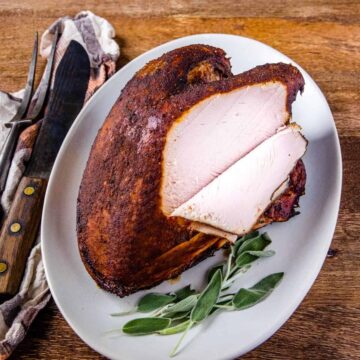
Feeding a big crowd? Two smaller turkeys cook faster and more evenly than one giant bird. You can also roast a whole turkey plus an herb roasted split turkey breast for extra white meat.
How to Thaw a Turkey
The safest way is in the refrigerator. Leave the turkey in its wrapper on a rimmed sheet pan to catch any drips, and allow about 1 day for every 4 pounds.
Running short on time? Submerge the wrapped turkey in a sink or cooler of cold water and change the water every 30 minutes. Plan on about 30 minutes per pound, and roast it as soon as it's thawed.
Turkey Roasting Time at 350°F
Figure about 13 minutes per pound for an unstuffed turkey. Use these times as a guide for when to start checking, and let the thermometer make the final call.
| Turkey Size | Time |
|---|---|
| 10-12 pounds | 2 to 2½ hours |
| 12-14 pounds | 2½ to 3 hours |
| 14-16 pounds | 3 to 3½ hours |
| 16-18 pounds | 3½ to 4 hours |
Ingredient Notes

- Whole turkey: I recommend a 12 to 14-pound bird for this recipe. Most supermarket turkeys are already injected with a salt solution (check the label for words like "enhanced" or "contains up to 8% solution"), so they're already seasoned on the inside.
- Butter: One stick, melted. I like Kerrygold unsalted butter for its rich flavor. The butter browns the skin and gives the seasoning something to stick to.
- Kosher salt: I use Morton Kosher Salt. Some goes in the cavity and the rest goes on the skin, so the whole bird is seasoned.
- Poultry seasoning: A ready-made blend of herbs like sage and thyme that tastes like Thanksgiving in a jar. I use Spice Islands.
- Aromatics (optional): A quartered onion plus a few sprigs of fresh rosemary and thyme in the cavity add a little flavor to the meat and a lot to the drippings. Keep them loose so hot air can still circulate inside the bird.
See the recipe card at the bottom of this post for the complete list of ingredients and measurements.
How to Make Easy Roasted Turkey
- Set up the oven. Move a rack to the lower third of the oven and preheat to 350°F. A turkey is tall, and the lower rack keeps the breast in the middle of the oven, away from the top heating element.
- Prep the turkey. Pull the neck and giblet bag out of both cavities (check the neck end too!), drain any juices, and trim off excess fat around the neck. Save the neck for gravy or stock. Then pat the turkey dry inside and out with paper towels. The drier the skin, the crispier it gets.
- Season the cavity. Sprinkle about 1 tablespoon of salt inside, then add the onion and herbs if you're using them. Tie the legs together with kitchen twine and tuck the wing tips under the body so they don't burn.


- Butter and season. Set the turkey breast side up on a rack in a roasting pan. Brush it all over with melted butter, then season every side with the poultry seasoning, pepper, and the rest of the salt. Don't forget the underside and the sides of the legs.
- Roast. Slide the turkey into the oven and leave it alone. If you have a leave-in thermometer, insert the probe into the thickest part of the breast without touching the bone, so you can watch the temperature without opening the door. For a 12 to 14-pound turkey, start checking after about 2 hours.


- Check both temperatures. The breast is done at 160°F. For the thigh, push an instant-read thermometer into the thickest part, between the drumstick and the body, without touching the bone. It should read at least 170°F. Check a couple of spots, since one side often cooks faster than the other.
- Rest. Move the turkey to a cutting board, tent it loosely with foil, and let it rest for 30 minutes. The juices settle back into the meat, and the breast climbs the last few degrees to 165°F.
Scott's Tips
- My testing notes. After about 20 Thanksgivings, I've roasted, smoked, injected, and spatchcocked plenty of turkeys. When I want the most reliable result with the least work, I keep coming back to this one-temperature, no-baste method.
- Use two thermometers. I keep a leave-in thermometer in the breast so I can watch the temperature the whole time without opening the oven. When it gets close, I grab my ThermoWorks Thermapen instant-read thermometer to check several spots in both breasts and both thighs and make sure the turkey is cooked all the way through.
- Don't let the drippings burn. If the pan looks dry and the drippings start to scorch, pour ½ cup of water or broth into the bottom of the pan. Burnt drippings make bitter gravy.
- Cook the stuffing on the side. Stuffing inside the bird has to reach 165°F too, and by then the breast is overcooked. Bake your cornbread dressing or traditional bread stuffing in a dish instead.
- Put the resting time to work. That 30-minute rest is when you make the gravy and slide the dressing and rolls into the oven, so everything hits the table hot.
- Want more flavor? Try my Cajun turkey with a homemade butter injection, or take it outside for a smoked spatchcock turkey.

How to Make Gravy from the Drippings
While the turkey rests, you have just enough time to turn those pan drippings into about 4 cups of gravy. I thicken mine with cornstarch, which is quick, foolproof, and won't turn lumpy.
You'll need: the pan drippings, about 3 cups of Swanson Unsalted Chicken Broth, 3 tablespoons cornstarch, ⅓ cup cold water, and black pepper.
- Separate the fat. Pour the drippings into a fat separator or a large measuring cup. Let the fat rise to the top for a few minutes, then pour or spoon it off.
- Scrape up the browned bits. Set the roasting pan over two burners on medium heat. Add 1 cup of the broth and scrape up all the browned bits stuck to the bottom of the pan. That's where the flavor is!
- Simmer. Pour the pan liquid and the skimmed drippings into a saucepan. Add enough broth to make about 4 cups, then bring it to a simmer.
- Thicken. Whisk the cornstarch into the cold water until smooth, then slowly whisk it into the simmering liquid. Simmer for 1 to 2 minutes, until it coats the back of a spoon. Want it thicker? Add a little more slurry.
- Season. Taste before adding any salt, since the drippings are already seasoned. Finish with black pepper.
Want one less thing to do on Thanksgiving Day? Make my make-ahead turkey gravy up to 3 days early. Once the turkey comes out of the oven, skim the drippings and whisk them into the gravy while it reheats for that fresh-from-the-pan flavor.
How to Carve a Turkey
A sharp carving knife and a large cutting board with a juice groove make this a lot easier. Here's how I break down a whole bird:
- Remove the legs. Pull a leg away from the body and slice through the skin. Press the leg down until the hip joint pops, then cut through the joint. Repeat on the other side.


- Separate the drumsticks and thighs. Find the joint between them and cut straight through it.
- Remove the wings. Pull each wing away from the body and cut through the shoulder joint.


- Take off the breasts. Cut down one side of the breastbone, then keep the knife close to the ribcage and work the whole breast off in one piece. Repeat on the other side.


- Slice. Cut the breasts crosswise into ¼ to ½-inch slices, and slice the thigh meat off the bone.
- Plate it. Arrange the sliced breast in the middle of a platter with the drumsticks, thigh meat, and wings around it.


What to Serve with Roasted Turkey
This is a classic Thanksgiving turkey, so it goes with all the classic sides. I like to balance something creamy, something green, and something a little sweet:
- Instant Pot Garlic Mashed Potatoes
- Green Bean Casserole without Soup
- Sweet Potato Soufflé
- Easy Homemade Cranberry Orange Sauce
And save room for dessert! A slice of classic Southern pecan pie is how we finish every Thanksgiving at my house.

Make-Ahead Tips
The turkey is best roasted the day you serve it, but a little prep the day before makes Thanksgiving morning a lot calmer.
- The day before: Make sure the turkey is fully thawed (press on the thighs and check inside the cavity for ice). Quarter the onion, mix the salt, pepper, and poultry seasoning in a small bowl, and set out the roasting pan, rack, and kitchen twine.
- Work backward from dinner: Start with the time you want to eat, subtract 30 minutes for resting, then subtract the roasting time and 15 minutes for prep. For a 13-pound turkey and a 3:00 dinner, start prepping around 11:30 and get the turkey in the oven by 11:45.
Storage and Reheating
Get leftovers into the fridge within 2 hours of the turkey coming out of the oven. Carve the meat off the bone first so it chills faster and takes up less space.
- To store: Keep sliced turkey in an airtight container in the refrigerator for 3 to 4 days.
- To reheat: Put the turkey in a baking dish, add a splash of broth or leftover gravy, and cover it tightly with foil. Warm it in a 325°F oven until heated through, about 15 to 20 minutes. Small portions reheat well in the microwave, covered, with a little broth.
Freezing
Freeze carved turkey in freezer bags or airtight containers for up to 3 months. A spoonful of broth or gravy in each bag keeps it from drying out. Thaw overnight in the fridge. Leftover turkey is perfect in turkey noodle casserole or Instant Pot turkey pot pie.
Frequently Asked Questions
Both work. I prefer 350°F because it browns the skin well without needing a high-heat start, and it shaves some time off compared to 325°F. Whichever you choose, go by the internal temperature, not the clock.
It's not necessary to rinse your turkey before cooking it. In fact, the USDA recommends not rinsing your turkey because of the risk of contaminating your sink and spreading harmful bacteria in the kitchen.
No, roast it uncovered so the skin can brown and crisp. If the breast or wing tips get dark before the turkey is done, lay a loose tent of foil over just those spots for the rest of the roasting time.
For this recipe, no. Most supermarket turkeys are already injected with a salt solution, and brining them on top of that can make the meat too salty. If you buy a fresh, untreated turkey and want to brine it, cut back on the salt in this recipe.
A roasting pan with a rack is the easiest option, since the rack lets hot air reach the bottom of the turkey. No roasting pan? A sturdy rimmed half sheet pan with a wire rack works for turkeys up to about 14 pounds. A disposable foil pan works too, as long as you set it on a sheet pan for support.
More Turkey Recipes



📖 Recipe

Easy Roasted Turkey Recipe
Equipment
Ingredients
- 12-14 pound whole turkey, fully thawed
- 8 Tablespoons unsalted butter, 1 stick, melted
- 2 Tablespoons Kosher salt, divided
- 1 teaspoon freshly ground black pepper
- 1 teaspoon poultry seasoning
Optional Aromatics
- 1 medium yellow onion, quartered
- 2-3 sprigs fresh rosemary
- 4-5 sprigs fresh thyme
Instructions
- Move an oven rack to the lower third of the oven and preheat to 350°F.
- Remove the neck and giblets from both cavities and drain any juices. Trim excess fat from the neck area, then pat the turkey dry inside and out with paper towels.
- Sprinkle about 1 tablespoon of the salt inside the cavity, and add the onion, rosemary, and thyme if using. Tie the legs together with kitchen twine and tuck the wing tips under the body.
- Set the turkey breast side up on a rack in a roasting pan. Brush all over with the melted butter. Mix the remaining salt, pepper, and poultry seasoning, and season the turkey on all sides.
- Roast uncovered for 2½ to 3 hours, until the thickest part of the breast reads 160°F and the thickest part of the thigh reads at least 170°F. Start checking after 2 hours.
- Move the turkey to a cutting board, tent loosely with foil, and rest for 30 minutes before carving.
Notes
- Temperatures: Pull the turkey at 160°F in the breast and 170°F in the thigh. The breast will rise to 165°F as it rests. A leave-in thermometer in the breast lets you track it without opening the oven, and an instant-read thermometer is best for double-checking the thighs.
- Timing: Figure about 13 minutes per pound at 350°F for an unstuffed turkey.
- Browning: If the breast or wing tips darken too quickly, cover just those spots loosely with foil.
- Drippings: If the drippings start to scorch, add ½ cup of water or broth to the pan.
- Salt: Using Diamond Crystal kosher salt, use about twice as much. For a kosher turkey, use half the salt.
- Quick pan gravy: Skim the fat from the drippings. Scrape up the browned bits in the pan with 1 cup of chicken broth, then add enough broth to the drippings to make 4 cups and bring to a simmer. Whisk in 3 tablespoons cornstarch mixed with ⅓ cup cold water and simmer until thickened. Taste before adding salt.
- Storage: Refrigerate leftovers within 2 hours for up to 3 to 4 days, or freeze for up to 3 months.
Nutrition
* All nutrition information we provide are estimates based on third party calculators. We encourage you to calculate these on your own for accurate results.



Leave a Reply